Showing posts with label Preserved Railways. Show all posts

Tuesday, 27 August 2013

The Midland Railway-Butterley (MR-B), Vintage Train (VT) event

From time to time the MR-B takes its VT out of the Matthew Kirtley museum building where it normally lives and gives it an airing. August Bank Holiday weekend 2013 was its most recent appearance.


This is not just having a train to look at but it is run in normal revenue service. 


I think that this a brave thing to do because the coaches have been beautifully restored and must be worth a considerable amount of money. 


The possibility that they may get damaged, (feet on seats, spilt drinks etc.) would make me think twice about it but as I said, a brave decision.


As befits a vintage train, a vintage loco is required.
P1050034

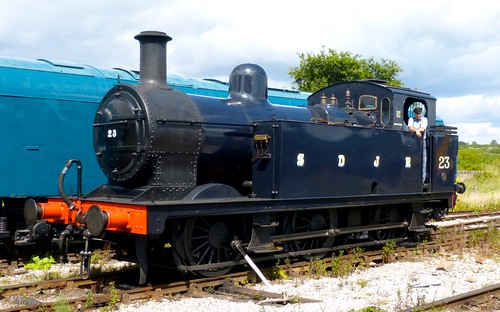
This turned out to be a ‘Jinty’ 0-6-0T loco currently painted in the old Somerset and Dorset Joint Railway livery of Prussian Blue and numbered 23. The reason for this colour scheme is that it was agreed between the MR-B and Bachmann who are to produce an ‘OO’ scale model of it.


Formerly numbered 47327 by British Railways, This Midland Railway designed machine was built in 1926 by The North British Locomotive Company of Glasgow.


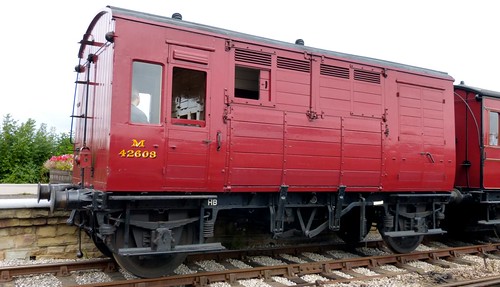
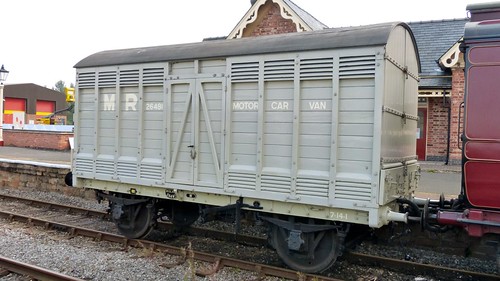
There are six vehicles that make up the train. Four of them are passenger coaches whilst at either end is a vehicle that would be expected to run as coaching stock. One being a Horsebox and the other a Motor Car Van.


The horsebox, No. 42608 was built in 1948 by British Railways to an LMS design which itself was derived from a Midland Railway (MR) design of 1904. Their use was primarily for the transport of racehorses who were often accompanied by a groom who travelled in an additional compartment. He/she had access to the horse(s) so that they could be fed and watered.
 

P1050328


The Motor Car Van, built in 1916 by the MR at Derby as its No. 26481. 


One of its known uses was the carriage of Rolls-Royce car chassis to the various coach builders who were going to build on them. 


This van has its main doors in the ends to allow straight in and out loading.


It was withdrawn from service in 1960.


P1050349


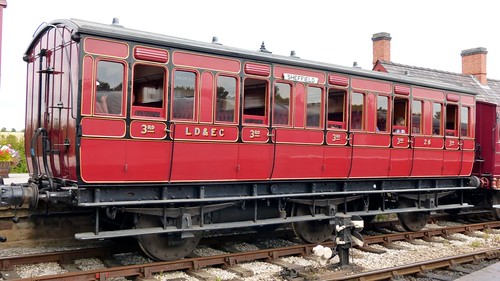
 This coach was built for The Lancashire Derbyshire & East Coast Railway by ‘Ashbury’s of Manchester’ in 1896 at a cost of £495. 


It was originally numbered 6 but carries 26 at the moment. However it will revert to 6 at its next repaint.


Withdrawn from passenger service in 1938, it was converted into a tool van. 


The only surviving item of rolling stock from the LD&ECR.
P1050329


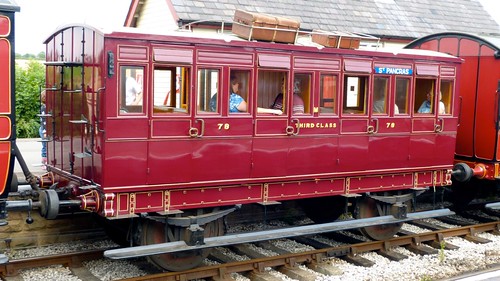
No. 78 is the oldest coach in the collection dating from 1866 and probably built at Derby.


Withdrawn in 1890 it then became part of a bungalow at East Bridgford in Nottinghamshire.


It is interesting to note the wooden buffer heads and the luggage on the ‘roofrack’. This being a carry over from stagecoach days. It was rescued in 1983.


P1050330


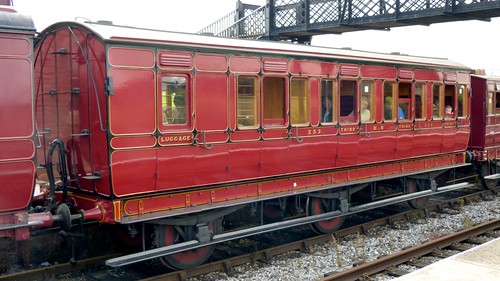
Of similar appearance to No. 6/26, this brake third coach was built in 1884 in Derby as No. 253. It was originally turned out as a 5 compartment coach but was converted into a brake sometime later.


Withdrawn in 1910, it was further converted into a service vehicle. It was rescued in 1974 from Shotton steelworks where it had become a duck shooters hut. 


Restoration was completed in 1990.


P1050350


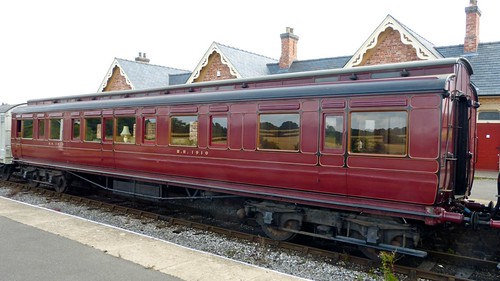
The only bogie coach in the train is this 1912 built clerestory roofed vehicle which again was built in Derby. 

It was built for King George the 5th and numbered 1910 to commemorate the date of his coronation. 


Not often used, it became a special saloon. Withdrawn in 1958 and rescued for the museum, it was restored in the 1980’s
 
P1050351


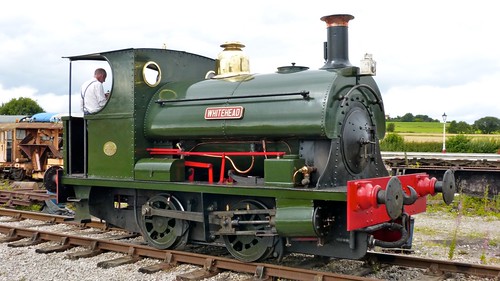
To provide additional interest on the day, a ‘freight’ train hauled by ‘Whitehead’ was in use.

'Whitehead' is an 0-4-0 Saddle Tank was built by Peckett and Sons  of Bristol in 1908.
 
 
P1050079


Below, it is seen with its train laying over at Butterley waiting for its next trip.


P1050323


Thursday, 15 August 2013

The Steeple Grange Light Railway


An evening visit to

The Steeple Grange Light Railway (SGLR)

P1040902


I was fortunate recently to be able to attend a ‘Transpire’ (The Chesterfield Bus Society) 
visit organized by Shayne Howarth to the SGLR.


The railway is located on the outskirts of Wirksworth in Derbyshire and alongside the High Peak Trail to which there is direct access.


Living locally, I decided to forego going to Chesterfield for the bus ride there. I immediately regretted my decision when I saw the groups choice of transport.


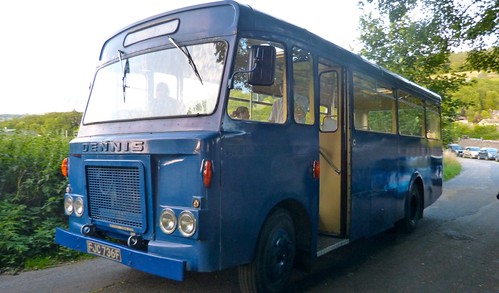
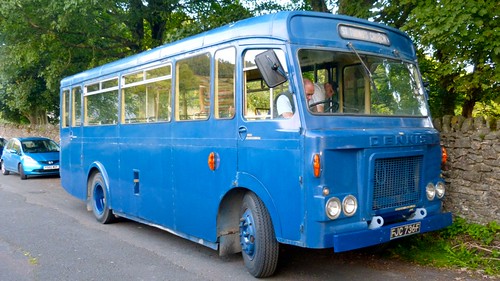
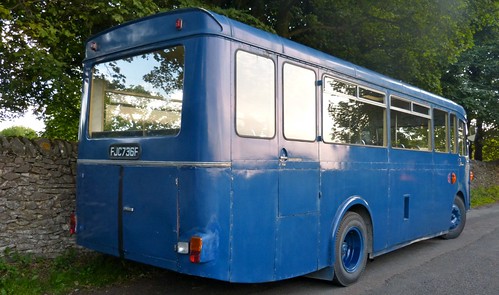
This turned out to be FJC 736F. One of only two Dennis Pax buses specially built for Llandudno UDC in 1968 and I think the only one to survive. They were for services up the Great Orme and to St. Tudno’s church. 


They replaced two Fodens with Metalcraft bodies built in 1951 


P1040938


I apologise for the poor quality of this image but I had a choice between this and getting run over !!!


I have perhaps gone overboard with the images of the bus but I have done so because of its rarity.


It also brings back memories of riding on it in Llandudno in 1968 or ’69 when it the had a cream top half to go with the blue lower half.

P1040940

P1040941


The SGLR is built to a gauge of 1 foot 6 inches and runs on the trackbed of what was a standard gauge line running from the Steeple House Junction on The Cromford and High Peak Railway up what is known as the ‘Killers’ branch. The name derives from the brothers who owned it and not to anything more sinister.


The C&HPR line dates from 1830 when horses provided the traction whilst the SGLR dates from 1985.


A lot of the loco’s and rolling stock come from an industrial background, most having worked in quarries, mines and factories etc.

P1040933


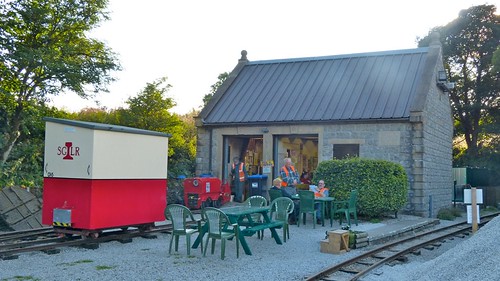
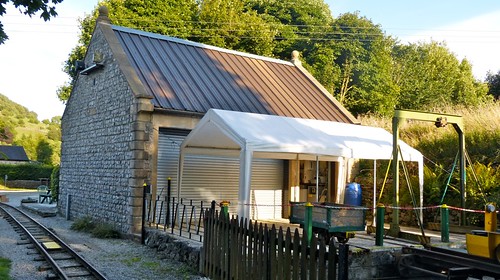
The ‘centre’ of operations is this sturdily built stone engine house which provides cover and accomodation for some of the loco’s and their crews.


P1040912

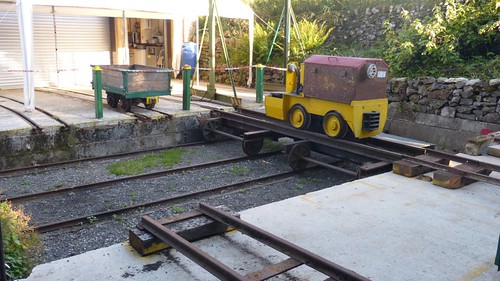
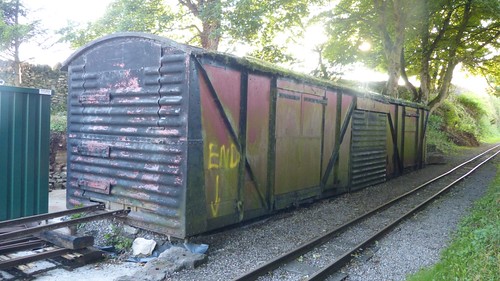
To the rear is a paved area with a heavy duty hoist and access to the right of the image to a two track traverser which allows loco’s to be securely stored in a modern container in what appropriately were old standard gauge railway vans.


P1040909


P1040911


 There were two trains in service.


The first of which took the members assembled up the branch in the direction of Middleton to its current end at a little over half a mile distant.


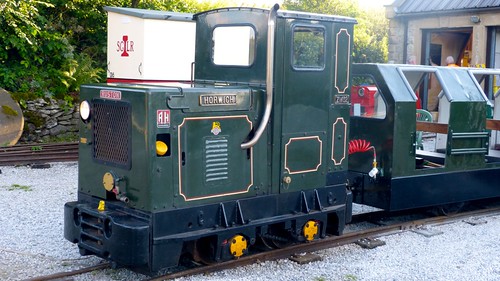
This comprised this Ruston and Hornsby built 4 wheel diesel loco dating from 1957 coupled to two former NCB ‘manriders; which came from Bevercotes colliery in Nottinghamshire. The ‘manriders’ were originally built to a gauge of 2 feet 3 inches so they both needed to be re-gauged.


P1040900


 The Ruston, named ‘Horwich’ was built for and named after the British Railways works in Lancashire where it worked. It then resided in a museum at Blaenau Ffestiniog from where it was purchased in 1997. 


P1040898


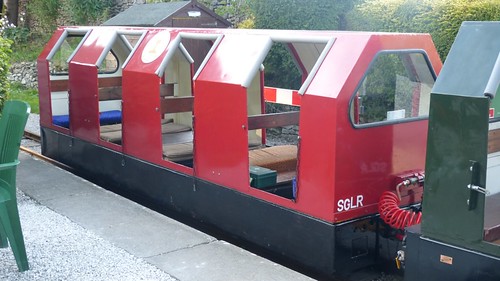
The second which runs to the Steeple house quarry was comprised of two four seat ‘manriders’ hauled by ‘Greenbat’.

The manriders came from the Ladywash Mine at Eyam in Derbyshire.

P1040892

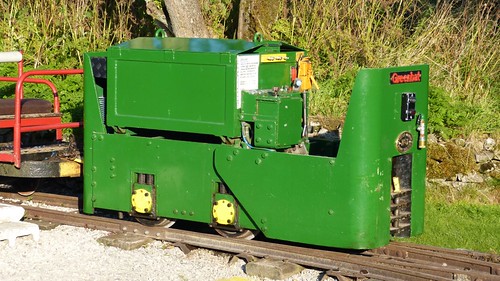
 Greenbat was built in 1960 by Greenwood and Batley and is a 5 H.P. battery electric that spent most of its earlier working life in factories.


P1040893


 Here we can see ‘Greenbat about to take the branch off to the left to Steeple house quarry. The quarry has been designated as a ‘Site of Special Scientific Interest (SSSI) because of the fossils dating back millions of years that can be seen.


P1040927


 The track as it wends its way through the woods in typically delightful narrow gauge style.


P1040924


 The end of the line in the quarry. If the first barrier fails to stop you, the second one certainly will.


P1040922


P1040942


As the main line ascends towards its present terminus on the way to Middleton, it passes what is known as Dark quarry where the railway has built a shed which accomodates various items of rolling stock.


P1040918


And finally, a footnote (sorry about that). 


Is this the shortest temporary platform on any UK railway ??


Conclusions then. 


A excellent outing made even better by the very obliging and welcoming ‘crew’ at the SGLR. 


Combined with perhaps a visit to the Ecclesbourne Valley Railway and/or the nearby National Stone Centre it would make a good day out for those who have to travel further than I did.


Further images of the SGLR are here  Flickr 


Friday, 2 August 2013

THE WELSHPOOL AND LLANFAIR LIGHT RAILWAY (WLLR) Part 8 of 8

Whilst one of the purposes of the line was for the movement of freight, there is little freight stock around. I suppose that with the line having become more fare paying passenger orientated, that this is inevitable.


The freight stock visible on the day is all shown here.


P1030902


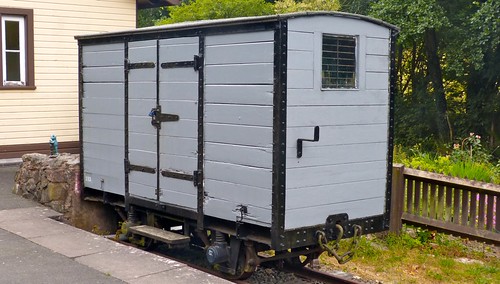
Parked in the bay at Welshpool is this van. I suspect having seen others like it that it originated with the Royal Navy.


P1030891


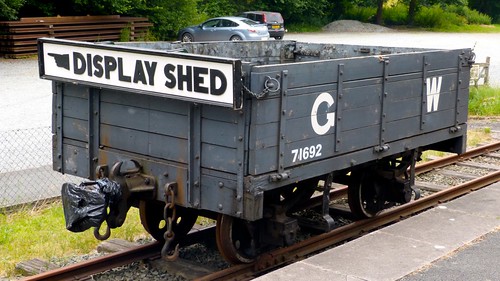
This four plank open goods wagon displayed in 


Great Western freight grey is used as a signpost to the display shed where the two out of service steam loco’s referred to earlier are stored.


P1030937


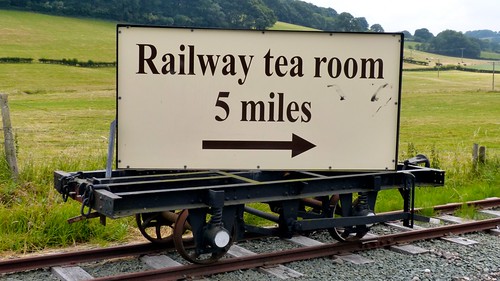
Approximately half way along the line is a halt at Sylfaen where a siding holds the three wagons seen here.


This tiny flat wagon draws attention to the excellent tea room located at Llanfair Caereinion.


P1030939


P1030938


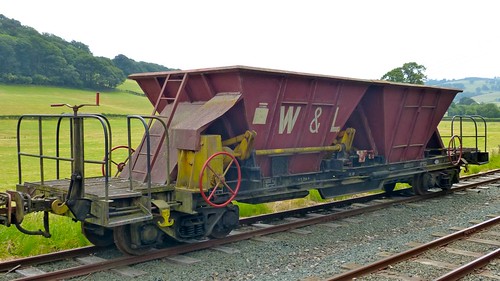
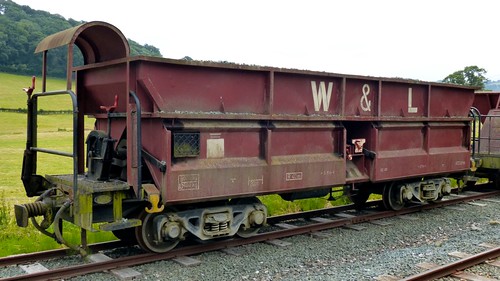
While the two bogie hopper wagons which presumably are used for carrying track ballast.


Both I believe came from Romania. 


In conclusion then. 


An interesting day out with sufficient to keep both the enthusiast and casual visitor interested. The staff were welcoming, friendly and knowledgeable.


Try to pick a day when there are two loco's in steam.


Recommended !


THE WELSHPOOL AND LLANFAIR LIGHT RAILWAY (WLLR) Part 7 of 8

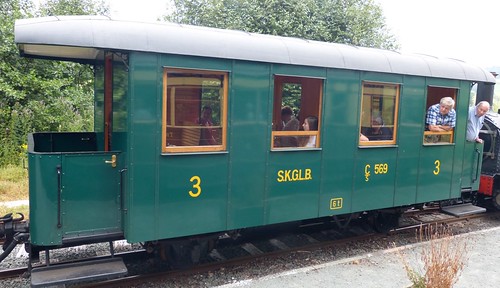
Another import from the ZB was this newer steel bodied coach again built by WMFAG at Graz in 1925.


P1030927


A 4 wheel second open, It was built for the Salzkammergut Lokalbahn (SKGLB). in Austria and is finished in SKGLB livery as its No. C569.


Initially running on the WLLR in the ZB livery of red and cream and numbered B24.

THE WELSHPOOL AND LLANFAIR LIGHT RAILWAY (WLLR) Part 6 of 8

Other coaching stock in evidence on the day were.

P1030859

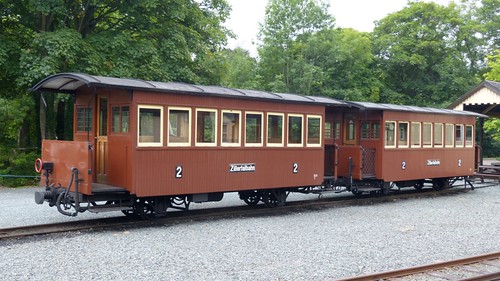
These two former 4 wheel ZB Brake Third open coaches numbered B14 and B16.


These wooden bodied vehicles were built in Graz (Austria) by Waggon und Maschinen Fabrik A.G. (WMFAG) in 1901/2 and came to the WLLR in 1968.


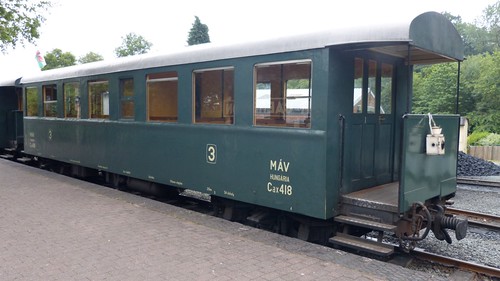
Further imports were 2 bogie coaches from Hungary.


P1030863


Built by and for The Hungarian State Railways (MAV) in 1958 at Debrecen.

THE WELSHPOOL AND LLANFAIR LIGHT RAILWAY (WLLR) Part 5 of 8

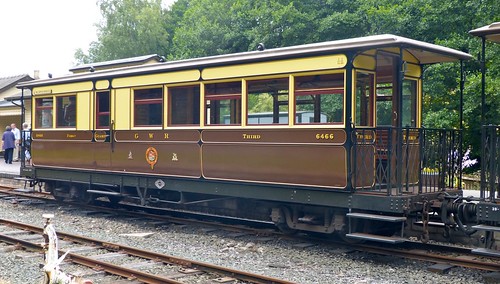
When the line opened, the coaching stock was built by  R.Y. Pickering of Wishaw near Glasgow.


These are long gone having been scrapped when the passenger service terminated in 1931. 

P1030949

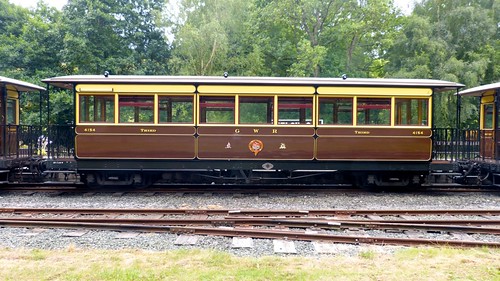
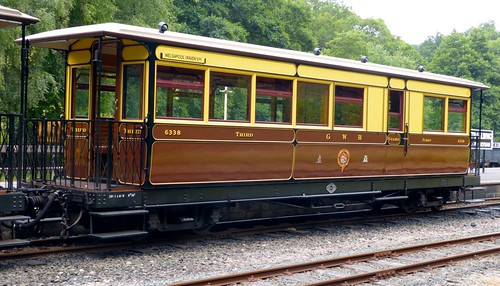
Fortunately the WLLR was able to commission the building of three replica coaches.


These came from the Boston Lodge works of the Ffestiniog Railway earlier this century and are finished in GWR coaching stock livery.


There are two First/ Thirds, numbers 6466 and 6338 and a Full Third number 4154.

P1030948

The standard of finish on these coaches is superb and I can say that in many years of railway interest, they are the best I have ever seen.

P1030947

THE WELSHPOOL AND LLANFAIR LIGHT RAILWAY (WLLR) Part 4 of 8

There are two other steam loco’s that are available for public inspection and these reside in a display shed just west of Welshpool station.

WLP1

Unfortunately, such are the constraints of the shed that I found it impossible to take reasonable image’s of them so I am grateful to Andrew Charman, the Press Officer on the WLLR for the use of both the images seen here.


First is No.6, a ’Mallet’ 0-4-4-0T articulated locomotive named ‘Monarch’.


Built in 1953 by  W.G. Bagnall, it arrived on the WLLR in 1966. It came from Sittingbourne and at one time went to the Ffestiniog Railway before being returned to the WLLR.


Listed as ‘static at Welshpool’ and ‘being cosmetically restored’. I think it unlikely that it will be seen in service any time soon!

WLP2

The other shed resident is a loco that saw service during the Second World War. Built by the Société Anglo Franco-Belge des Ateliers de la Croyère at Raisemes  in France. It was delivered to the German army in 1944 and captured in a stores depot by the Americans.


Sold in 1946 to the Styrian Government Railways in Austria and then on to The Zillertalbahn (ZB) again in Austria from where it arrived on the WLLR in 1969.


Originally a tender loco, It was converted to a tank loco in 1957 and It is now an 0-8-0T and was given the name of ‘Sir Drefaldwyn’ (translated as ‘Montgomeryshire’) by the WLLR.  


Again like Monarch, it might be some time before it is seen in service again.

THE WELSHPOOL AND LLANFAIR LIGHT RAILWAY (WLLR) Part 3 0f 8

P1030867

There is a small fleet of diesel’s that support the steam fleet.

 No.7 ‘Chattenden’ an 0-6-0 DM with jackshaft drive was built in 1947 by E.E Baguley Ltd. for the Drewry Car Company and at one time worked for the Admiralty. It was sold to the Chattenden and Upnor Railway before coming to the WLLR in 1968. 

It has recently been re-built to a new dual braked standard.


P1030869


No. 17. another 0-6-0DM was built by the Diepholzer Maschinenfabrik (Diema) in 1979 for the Taiwan Sugar Corporation. It arrived on the WLLR in 2004


P1030868


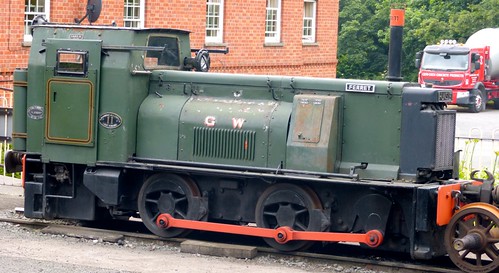
No 11 named ‘Ferret’ was built by The Hunslet Engine Company as works number 2251 in 1940.

Again it saw service with the Admiralty before coming to the WLLR in 1971. It currently wears lined GWR green loco livery.


Wednesday, 31 July 2013

THE WELSHPOOL AND LLANFAIR LIGHT RAILWAY (WLLR) Part 2 of 8


On any railway, the locomotives attract most attention especially when those locomotives are steam powered.


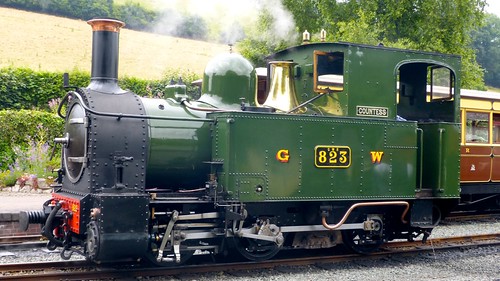
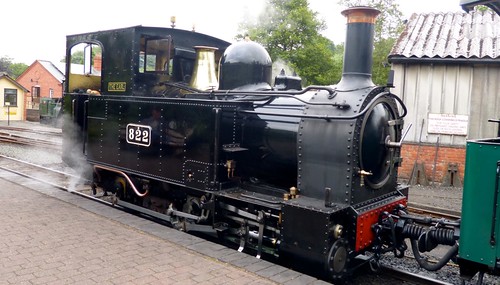
No.’s 822 & 823 ‘The Earl’ and ‘Countess’ respectively are the original 0-6-0 tank loco’s built for the line in 1902 by Beyer Peacock.


The liveries and the number plates reflect Great Western Railway influence. Needless to say, the paint job on both loco’s is excellent. 


P1030934


P1030866


The line came into GWR ownership with the takeover of Cambrian Railways in 1923 and passed to British Railways in 1948 at nationalization. 


THE WELSHPOOL AND LLANFAIR LIGHT RAILWAY (WLLR) Part 1 of 8


P1030861


It is 25 years since I last visited the WLLR. On that visit I was accompanied by sons Andrew and Robert. This time, I only had Andrew for company because Robert has moved onto other interests (like beer, women and Sunderland AFC).


Authorized by the Light Railways Act of 1896, it opened in April 1904 as a ‘Common Carrier’ line, it was intended to improve communications in the area. 


Never having turned a profit it closed in November 1956.


Taken over by enthusiasts, it was re-opened progressively from West to East in 1963. Unable to use the original terminus in Welshpool, the railway now terminates at 

Raven Square on the outskirts of the town. 


The track gauge is 2 feet 6 inches and the distance between the termini is 8 and a half miles.


The image above shows the platform and station buildings at Llanfair Caereinion. The two coaches are dealt with in detail elsewhere in this piece.