Showing posts with label GWR class 56XX. Show all posts

Saturday, 22 April 2017

‘Scene’ at the Midland Railway Trust (MRT) at Butterley on Dennis Basford’s railsroadsrunways.blogspot.co.uk

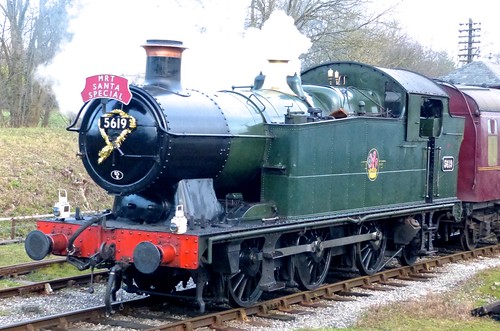
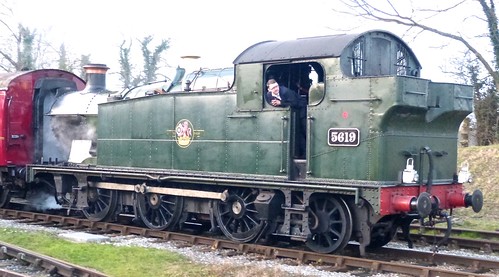
On the 24th. of December 2016, I published a blog about a ‘British Railways’ (BR) former ‘Great Western Railway’ 0-6-2T locomotive No. 5619 which at that time was employed on ‘Santa Specials’ in ‘BR’ green livery and carrying the later version of ‘BR’ logo.


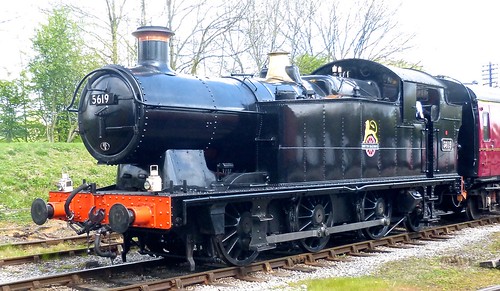
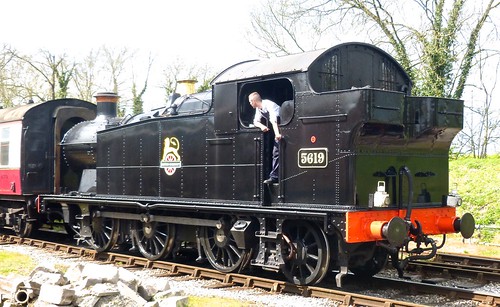
Over the winter of 2016/2017, No. 5619 has been repainted into ‘BR’ black livery and now wears the earlier ‘BR’ logo which was known to enthusiasts as ‘The Cycling Lion’.


No. 5619 a member of the 56XX Class which was built between 1924 and 1928 specificaly for use on the valley lines of South Wales, primarily hauling coal.


5619 ‘British Railways’ 0-6-2T Black Class 56XX

on Dennis Basford’s railsroadsrunways.blogspot.co.uk


5619 ‘British Railways’ 0-6-2T Black Class 56XX on Dennis Basford’s railsroadsrunways.blogspot.co.uk


5619 ‘British Railways’ 0-6-2T Black Class 56XX /1

on Dennis Basford’s railsroadsrunways.blogspot.co.uk


5619 ‘British Railways’ 0-6-2T Black Class 56XX /1 on Dennis Basford’s railsroadsrunways.blogspot.co.uk

Saturday, 24 December 2016

‘Scene’ at the Midland Railway Trust (MRT) at Butterley on Dennis Basford’s railsroadsrunways.blogspot.co.uk

The ‘MRT’s current lack of steam power has been well documented in the railway press.


This has led to the hiring in of suitable locomotives through the summer and autumn to enable advertised steam services to be run.


The previous hiring of the ‘Metropolitan Railway’s No 1 was covered in my blog dated 05/04/16.


The hiring of L150 a former ‘Great Western Railway’ 2-6-2T Prairie tank loco in ‘London Transport’ livery was covered in my blog dated 04/09 2016.


This time it is the turn of another ‘Great Western Railway’ built loco an 0-6-2T tank.


No. 5619 a member of the 56XX Class which was built between 1924 and 1928 specificaly for use on the valley lines of South Wales primarily hauling coal.


5619 ‘British Railways’ 0-6-2T Class 56XX

on Dennis Basford’s railsroadsrunways.blogspot.co.uk


5619 ‘British Railways’ 0-6-2T Class 56XX on Dennis Basford’s railsroadsrunways.blogspot.co.uk


5619 ‘British Railways’ 0-6-2T Class 56XX /2

on Dennis Basford’s railsroadsrunways.blogspot.co.uk


5619 ‘British Railways’ 0-6-2T Class 56XX /2 on Dennis Basford’s railsroadsrunways.blogspot.co.uk

Thursday, 29 May 2014

‘Scene’ at the Great Western Society (GWS) facility at Didcot Part 1

A day out to Oxford mainly to see the buses (see elsewhere on my blog) also afforded me the time to catch the train from Oxford to Didcot where the ‘GWS’ are based. 


Although it was not a running day, there was plenty to interest me and from the assorted wagons on display, I have been able to make up a couple of typically ‘Great Western Railway’ (GWR) trains that will appear in later ‘blogs’.


Where vehicles have been restored, the standard is excellent and work is ongoing to restore many others.


The GWS site stands at the side of Didcot railway station and the sound of trains passing by on the main lines is a constant accompaniment.


Access is via an underpass from the mainline railway station and the site itself is spacious and well set out.


P1090230


 The coaling stage with the water tank on top dominates the 1930‘s built loco sheds seen to the right.

P1090254

Loco No. 5227 

A Great Western Railway (GWR) 2-8-0T of the 5203 class built at Swindon in 1924.

They were built for hauling coal trains from the South Wales coalfield over relatively short distances.

The loco was has been used to supply parts for the building of a class 47XX No 4709 freight loco at Didcot.

What is left is displayed to represent  loco’s that were in Woodhams scrapyard at Barry.


P1090296


Loco No. 6697

An 0-6 2T loco of the ‘GWR’ 56XX class built by Armstrong Whitworth & Co. at Newcastle in 1928.


This class of 200 loco’s were urgently needed to replace worn out machines taken over from the absorbed railways of South Wales. This led to the use of outside contractors, an unusual move for the ‘GWR’.


Sold into preservation in 1966 from Wrexham depot the loco came to Didcot in 1970, was restored cosmetically and is now on static display.


P1090407


Loco No. 18000

A gas turbine- electric loco (gte) was ordered by the ‘GWR’ in 1946 and delivered to 

‘British Railways’ in 1949. It was built by Brown Boveri and SLM in Switzerland.


The ‘GWR’ chose the ‘gte’ because at that time there was no single unit diesel electric that could haul what the ‘GWR’ King class loco could.


In service it proved troublesome and expensive to operate so was withdrawn in 1960. Returned to Switzerland, it was used in wheel to rail experiments. In 1975 it was displayed in Vienna. It was returned to the UK in the early 1990’s and was stored at Crewe. It spent some time on the Gloucester Warwickshire Railway as a static exhibit before coming to Didcot in 2011.


P1090401


Loco DL 26 named ‘The Rat’.

Built in 1957 by the Hunslet Engine Co. of Leeds. A lightwieght loco it is used for moving stock over the carriage shed traverser (see later).


British Railways (BR) class 05 was a very close relative and although this loco carries a  ‘BR’ totem it is in fact a loco produced for an industrial customer.


P1090389


Loco 08604 named ‘Phantom’.

Although it carries ‘GWR’ style number and nameplates it is a standard ‘BR’ 08 class shunter.


Built originally as D3771 at Derby, one of a class of 996. Shedded for many years at Tyseley, Birmingham it has been at Didcot since 1984.

P1090399


Diesel Railcar No.22

Built by the ‘GWR’ at Swindon in 1940/41to diagram A1. Powered by 2 AEC 105 HP engines this and its classmates were the forerunners of the mass introduction of Diesel Multiple Units that were to be produced in the early 1960’s at about the time that No. 22 was withdrawn. 


P1090380


No.190 Autcoach

Belonging to an earlier generation of passenger transport is this ‘GWR’ coach built at Swindon in 1933 to diagram A.30. Being non powered, they always worked with a loco in push-pull mode, the loco normally being a tank. 


A driving cab was fitted at the one end whilst the loco end is without windows.


No. 190 has been in preservation since 1970. The interior has been refurbished but the unit only operates on high days and holidays.


P1090381


The sheds that hold the coaching stock at Didcot are accessed by a traverser. The little red/cream ‘cabin’ is effectively a loco that pushes or pulls the bridging deck to line up with the vehicle required which is then extracted and placed elsewhere.


A clever device that saves a lot of points and trackwork in a limited space.


P1090309


There are a couple of direct links to Isambard Kingdom Brunel (IKB) at Didcot. The first of which is this remnant of pipework from ‘IKB’s unsuccesful ‘Atmospheric Railway’ (AR) in South Devon.


The story of the ’AR’ is far to lengthy and complex to be covered in detail here however it is a fascinating story and is well worth further investigation should you be so minded.


This piece of original pipework is seen set between a section of broad gauge track. 


After the failure of the ‘AR’ the hardware was disposed of. The section seen below was recovered from a site at Goodrington Sands near Paignton. It had been used for land drainage. The smaller sections that make up this pipe were discovered in 1993 by the South West Group of the ‘GWS’.


The other link to ‘IKB’ is to the ‘Broad Gauge’ (BG) itself. ‘IKB’ was of the opinion that a track gauge of seven feet would produce a more stable and a higher speed line. Indeed many hundreds of miles on the ‘GWR’ were so built before it was decreed that Stephenson’s gauge of four feet eight and a half inches became the Standard Gauge (SG).


Didcot has a short stretch of ‘BG’ Track and here we see it interlaced with ‘SG’ track to produce a dual gauge point.


P1090322


‘BG’ and ‘SG’ track side by side.

P1090324

A replica of a ‘GWR’ ‘BG’ loco named ‘Firefly’ stands in an adjacent shed when it is not in operation. Its construction took over 20 years entering service at Didcot in 2005.


The original loco of was designed by Daniel Gooch in 1840 as a 2-2-2 and it ran in service until 1870.


P1090333


 I think that Brunel’s original conception of the Broad Gauge was probably right in that it would have produced a more comfortable ride than the Standard Gauge.


The whole railway would have been bigger and more spacious. Just how much that would add to the cost of today’s HS2 ? I dread to think.


Tuesday, 4 February 2014

The Great Central Railway Winter Steam Gala 2014

For many years now, I have been attending this event which this year was spread over Friday, Saturday and Sunday of the 24th, 25th, and 26th. of January.


The format is that the GCR utilize their home based fleet together with a number of visiting guest locomotives to run a regular passenger service which is backed up by the same loco’s running on additional freight and Traveling Post Office workings. In addition there are turntable demonstrations at Quorn and Woodhouse station.


Something for everybody then and a good day out for all. 


The visiting Loco’s were 


Great Western Railway (GWR) class 56XX 0-6-2T No. 5643


Built in the mid 1920’s, the ’56’ were developments of the Rhymney Railway classes ‘M’ and ‘P’. 


The railways of South Wales at that time moved vast quantities of coal over fairly short distances and this type of loco proved ideal.


The same qualities can also be put to use on preserved lines swapping coal wagons for passenger coaches.


Built in 1925, 5643 is one of 9 of the class currently preserved. 


Having worked all its life in South Wales, it was withdrawn in 1963 went for scrap to the now famous ‘Woodhams’ scrapyard at Barry.


After several moves in preservation the loco moved to Cumbria and is now owned by the The Furness Railway Trust.


P1080520


P1080495


British Railways (BR) Standard class 7 4-6-2 No. 70013 ‘Oliver Cromwell’. Also known as the ‘Britannia’ class.


Only two of the 55 loco’s built between 1951 and 1954 survive. The other one being No. 70000 ‘Britannia’ itself.


After withdrawal after a very short working life 70013 became part of the National Railway Museums collection.


After spending some years at Bressingham Steam & Gardens in 2004 it was announced that the loco was to be returned to steam in time for the 40th. anniversary of the ending of steam.


It re entered service in 2008 and since that time has made regular public appearances.


During the gala a wreath was carried on the smokebox door in memory of Mick Pickering a GCR driver who passed away earlier in the month.


P1080670


British Railways (BR) Standard class 9F 2-10-0 No. 92214 ‘Cock ‘O the North’ a name it did not carry in service.


One of 9 surviving loco’s it did not carry the lined BR black livery in service either and although some people do not like loco’s carrying non authentic liveries, I think it looked gorgeous.


After the gala it was announced that 92214 is to stay on the GCR.


Designed and built in the 1950’s the 9F’s were destined to be the last steam loco’s built for BR. Its classmate 92220 being the very last.


P1080705


Hunslet 0-6-0T Austerity No 22. 


Unfortunately failed at Loughborough on the Friday and was withdrawn from the gala.


Designed for the Ministry of Supply for use in wartime, the Austerity’s were built in their hundreds. 


After the war, surplus loco’s were sold off. The LNER bought 75 and gave them the designation of J94.


They continued in BR service until the mid 1960’s most famously on the Cromford & High Peak Railway.


No.22 was built in 1956 and worked at the Appleby-Frodingham steelworks in Lincolnshire.


It is currently on loan from there and is normally resident on the Nene Valley Railway.


This image is produced here courtesy of my eldest son Andrew Basford.


He edits his own blog which can be found on 'Rudderless Railway Ramblings'.


20140124-0015


Loco’s from the GCR ‘fleet’


LMS 3F 0-6-0T No.47406


Was one of a batch of 35 loco’s built by the Vulcan Foundry

for the LMS in 1926.


Based on a Midland Railway design that dates back to 1889. Over 420 ‘Jinties’ as they were known were produced for the LMS between 1924 and 1931.


47406 was one of 9 Jinties ln ‘Woodhams’ scrapyard and was the last to leave as recently as 1983 for preservation on the GCR.


P1080568


LMS Ivatt class 2 2-6-0 No. 46521


One of a batch of 13 loco’s built at Swindon in 1953. Derived from Ivatt’s 2-6-2T tank loco, the addition of the tender with its greater carrying capacity for both coal and water gave the loco a greater radius of operation.


On the Saturday, 46521 was used on the turntable demonstration and here it is seen on its way to and from the demo.


P1080548


P1080612

BR standard class 2 2-6-0 No. 78019 

Is visually a close relative of the Ivatt 2-6-0. 65 of this class which were derived from their Ivatt forebears differed only in detail. 


The build dates for this class are shown as 1952 to 1954 which is interesting in that when the BR loco’s were in build in 1952 that their LMS forerunners were still being built until 1953.


78019 built at Darlington was another loco rescued from ‘Woodhams’ yard at Barry. After being ‘parked’ on the Severn Valley railway it came to the GCR in 1998.


P1080581


Two loco’s in green paint albeit in different shades.


Great Northern Railway (GNR) N2 class 0-6-2T No. 1744 currently in Apple green.


Designed by Nigel Gresley for the GNR and introduced in 1920. the class were mainly used on suburban duties out of Kings Cross. They would have been seen hauling sets of articulated coaches.


They performed similar duties around Edinburgh and Glasgow.


Their hauling capacity is put to good use on the well loaded GCR trains.


1744 became an LNER loco at the grouping and later entered BR service as No. 69523.


P1080597


Southern Railway (SR) N15 ‘King Arthur ‘class ‘Sir Lamiel’ 4-6-0 No. 777 currently in Malachite green.


All the loco’s in this class carried names from the fictional ‘Knights of the Round Table’.


Built in 1925 by the North British Locomotive Company in 1925. It was withdrawn from service in 1961 and although resident at the GCR it is part of the National Collection.


It too became part of BR stock as No. 30777.


P1080528


LMS Stanier class 8F 2-8-0 No. 48624. 


Another wearing loco carrying a livery that is not authentic to its class and as with the 9F in some quarters a contentious choice. 


As far as I know, no 8F’s carried the LMS express passenger livery but I think that it sits very well on the loco and is a pleasant change from plain black that adorns the other members of this class in preservation.


One of 852 built by or for the LMS or War Department between 1935 and 1946 as heavy freight loco’s. 48624 is the only surviving Southern Railway built loco having been built at Ashford in 1943 and is one of 14 survivors.


The class were used extensively in Europe and the Middle East.


Numbered 8624 in LMS days, currently it carries its BR number 48624 on its LMS livery.


P1080537


I have never visited a steam gala at the GCR when by way of contrast, a DMU has not turned up. This time was no exception.


We were treated to several runs by this BR class 127 which first came to the GCR in the 1980’s. Its 2 power cars have Rolls-Royce engines which sound lovely.


The standard of restoration is first class and although it was at a steam gala it attracted a considerable amount of attention.


P1080508


On the question of quality of restoration, I would offer the two following images which could be titled before and after.


Both are Gresley LNER teak stock. One has a long way to go, the other, superb. 


Well done.


P1080489


P1080584